Self-Defense Laws in Japan: How Can I Protect Myself?
Be in the know now rather than make a mistake later

We break down those tricky Japanese laws on self-defense so you know what’s what.
You’re walking home late at night. Someone is following you. You squirt pepper spray in the person’s face. You’re just defending yourself, right? Not quite. According to the laws on self-defense in Japan, you can quickly morph from the victim into the aggressor if the court deems it necessary.
Recently, Japan has been reeling from disturbing stories of stalking and the murder of women in particular. In Kobe, Megumi Katayama was stabbed to death in her building’s elevator by a stalker. In Kanagawa, Asahi Okazaki was stalked and allegedly murdered by her ex. These stories have led to a spike in the sale of pepper spray as women prepare to defend themselves. But legal experts warn that the law may not be on their side.
What Is Self-Defense?
 © Photo by iStock: Antonio_Diaz
Legal self-defense, or 正当防衛 (seitou bouei), is a tricky concept. What is considered self-defense in other countries may not fly in Japan. Article 36 of the Japanese Penal Code lays out the law. To use self-defense, you need to prove that:
- Your attacker broke the law, i.e., the attack was illegal.
- The attack was “imminent,” putting you in immediate danger. In other words, you had to defend yourself on the spot.
- Your defensive actions were proportionate to the attack. You did not counterattack with excessive force. Also, you did not defend yourself before or after the threat had passed.
What Is Not Self-Defense?
 © Photo by iStock: ajr_images
Article 36 also states that if you defend yourself “excessively” (かじょうぼうえい/kajoubouei), the judge may reduce or exempt you from punishment, depending on the circumstances.
Let’s give an example. A man gropes you on the train and swiftly exits at the next stop. You chase him down and beat the crap out of him. He deserves it, right? Maybe, but the court may see things differently. Why?
The court may judge that when your attacker escaped, the threat from the groping expired. You were no longer under “imminent” attack and your defensive actions appear vengeful. Your attacker may even press injury charges because you over-defended yourself.
What About Using “Weapons”?
 © Photo by iStock: Daria Kulkova
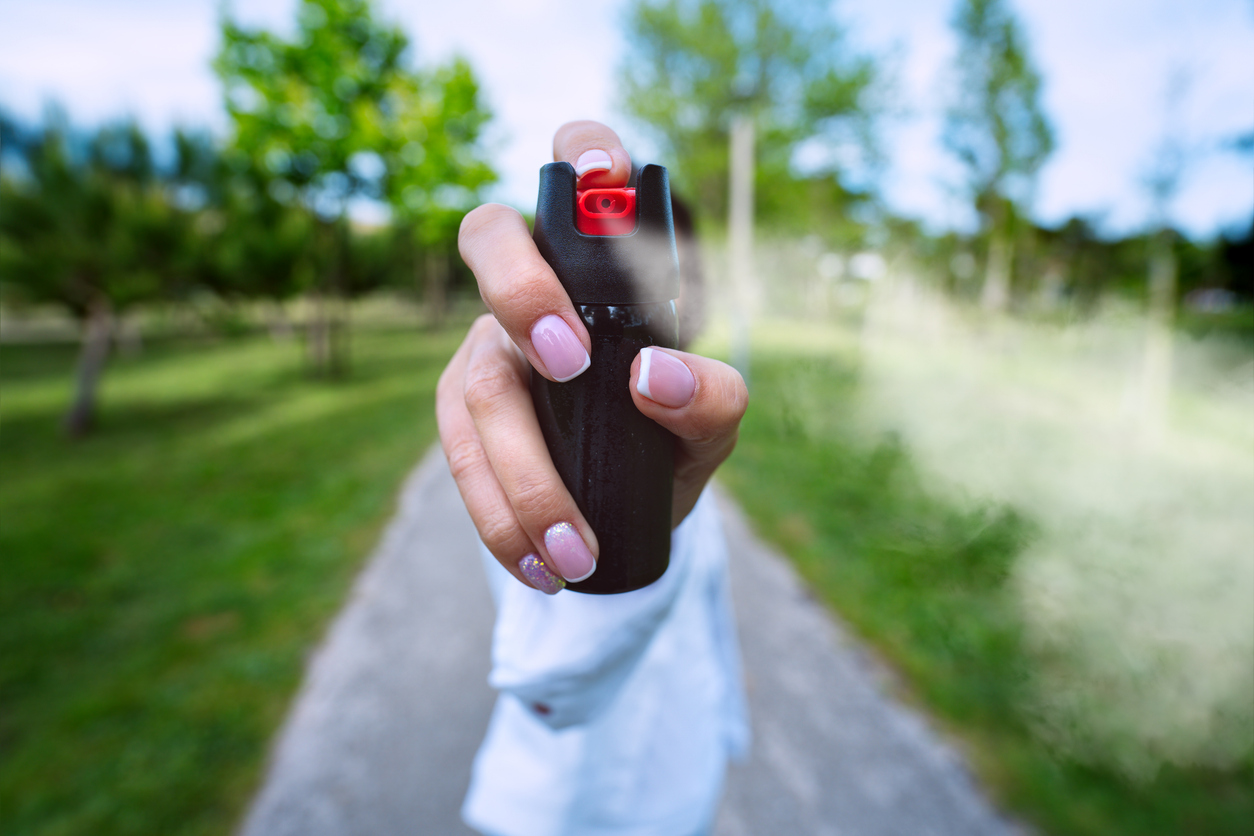
Let’s go back to the pepper spray example. If you carry pepper spray in public, you could be charged under the Misdemeanor Act. It’s illegal to hide and carry, without a valid reason, a knife, iron rod or any device that can be used to harm a person’s life or body. In this context, pepper spray can be considered a “device” that could hurt someone.
As mentioned in the first paragraph, if you spray your stalker even though he hasn’t touched you, he could press charges because you injured him without a good reason.
In the same way, if you were carrying a household item like a pair of scissors or an umbrella and you used it to over-defend yourself, you could be charged with injury. If convicted of injury under Article 204 of the Japanese Penal Code, you could face a fine of ¥500,000 or go to prison for up to 15 years. Talk about being on the wrong side of the law!
Domestic Violence: An Iffy Situation
 © Photo by iStock: solidcolours
Let’s look at another scenario. Your significant other has grown increasingly abusive and violent towards you. One day, when he threatens you as he usually does, you counterattack with such force that you kill him.
This happened in a 2014 domestic violence (DV) case. The Sapporo District Court acquitted the defendant on the grounds of self-defense. During a heated argument at home, the defendant stabbed her partner in the shoulder and he died. The court found that the attack was immediate. The victim kept hitting the defendant and she could not escape without defending herself. They also found that the stabbing was proportionate to the victim’s repeated violence.
However, in another DV case, in 2019, the Nagoya District Court did not allow the defendant to plead self-defense. Here, the defendant suffered years of abuse. One day, her husband proceeded to attack and threaten her as usual. She strangled him to death. The court judged her actions as “excessive” and that she should have tried to escape. However, she received a lesser sentence because of the history of violence.
These two cases clearly show that, even if parties have a long history of abuse, the court will always pay attention to the “imminence” and “proportionality” of the defendant’s actions.
What Can I Do To Defend Myself Legally?
 © Photo by iStock: coward_lion
Back to that old pickle. Now that you’re clued up about self-defense laws in Japan, what is legally permitted to protect yourself, others and your property from would-be attackers?
If attacked, you should:
- Block, push away or otherwise escape your attacker.
- Defend yourself only to the extent of stopping the attack.
- Scream, yell out or use a rape alarm/security buzzer to alert others around you.
- Report the attack at the nearest police station or koban (police box).
To minimize the risk of being followed and attacked:
- Be aware of your surroundings. Ditch the screen and earbuds.
- Walk in well-lit areas or areas with surveillance cameras. If the area looks dodgy, take a taxi.
- Live in an apartment higher than the second floor.
- Hang out men’s underwear/clothing on your washing line outside to showcase a male presence.
Other things to try for ease of mind:
- Learn aikido. Unlike other martial arts, in aikido, you do not attack but rather “redirect” the actions of your attacker to defend yourself.
- Keep pepper spray at home for emergencies. Although it is illegal to carry around as a self-defense weapon, it is completely legal to have it stored in your home.
- If you have any suspicions, inform your local police immediately. They may not be able to take immediate action without evidence, but they can increase patrols in your area.
Of course, it’s easy for things to get iffy in the heat of the moment because life is life. Whatever happens, keep your head on and protect yourself. Just don’t overdo it.
Have you or a friend ever experienced a situation like this? How did you defend yourself? Read more about groping in Japan and how you can deal with the dreaded chikan.
Disclaimer: This is not legal advice but for information purposes only. Please consult a qualified attorney if necessary.











Related Articles You Might Like

Groped, Scared, Disgusted: Stories Of Dealing With Chikan in Japan
We reached out to seven women who shared their first-hand accounts of dealing with assaults and harassment on Japan's rail system. They shared their stories...
By Lucy Dayman

How Safe is Tokyo for Women & Families?
The facts and how to protect yourself and your family in Tokyo.
By Hilary Keyes

10 Types of Harassment in Japan
From power struggles to peer pressure, here are 10 types of intimidation you’ll encounter in Japan—and some ways to turn the tables.
By Brie Schmidt

10 Laws that Benefit Women in Japan
As feminist movements gain traction and more women get elected to government offices, Japan is poised to become a nation where women thrive. Yet, there’s...
Leave a Reply